

Check out our schedule for upcoming Chinese medicine seminars and workshops approved for Australian CPD points. Get direct access to live tuition from international and local TCM and acupuncture experts.
If you can’t attend, no need to worry, we film many of these Chinese medicine seminars and make them available as online courses at a later date. Contact us if you have any questions…

- This event has passed.
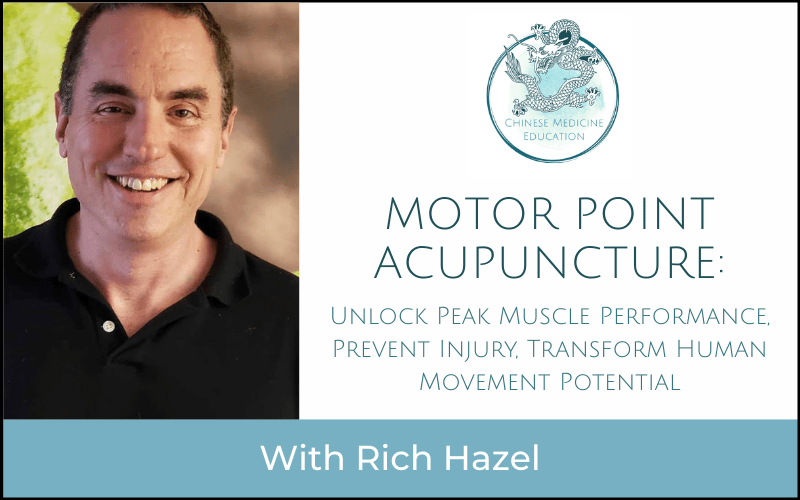
Motor Point Acupuncture: Unlock Peak Muscle Performance, Prevent Injury, Transform Human Movement Potential with Rich Hazel
UNLOCK PEAK MUSCLE PERFORMANCE:
TREAT INJURY, PREVENT RECURRENCE, TRANSFORM MOVEMENT POTENTIAL
Motor Point Acupuncture is one of the most powerful yet underutilised tools available to acupuncturists working with pain, injury, and performance-driven patients.
This workshop introduces a biomechanics-informed framework for understanding and treating muscle dysfunction. Rather than viewing muscles simply as sources of pain or tightness, participants will explore how muscles behave within larger movement systems — how they activate, coordinate, and transfer force throughout the body.
The three-day curriculum draws on the work of Dr. Vladimir Janda, integrating his approach to movement dysfunction with the clinical precision of motor point acupuncture. Day 1 establishes the theoretical and neurophysiological foundations. Day 2 applies those principles to sports performance and common lower-limb pain syndromes. Day 3 turns to Janda’s crossed syndrome model and its application to chronic spinal pain, headache, and nerve entrapment conditions that are frequently encountered in general practice but rarely addressed with a clear and effective treatment strategy.

WHY THIS WORKSHOP MATTERS
Many patients present as physically active and well-conditioned, yet continue to experience recurrent or stubborn injuries, persistent pain, and limited recovery. In these cases, the issue is often not a lack of strength but impaired muscle activation, timing, or coordination within the kinetic chain.
Conventional assessment approaches frequently fail to identify:
- Subtle muscle inhibition beneath apparent strength
- Compensatory movement patterns that perpetuate injury
- Inefficient force transfer between regions of the body
- The relationship between proximal dysfunction and distal pain
Motor point acupuncture, applied with an understanding of these mechanisms, offers a precise and evidence-informed approach to restoring efficient muscle behaviour and reducing the risk of recurrence.
WORKSHOP OUTLINE
Each day runs from 9:00 am to 5:30 pm and combines lecture, live demonstration, and supervised hands-on practice.
01 Foundations of Motor Point Acupuncture and the Janda Approach
Day 1 provides a thorough grounding in the “what” and “how” of motor point acupuncture, and introduces the Janda approach to muscle function and movement assessment. This is a new and complete explanation of the underlying science and clinical rationale, regardless of prior exposure to the subject.
Motor Point Acupuncture Foundations
- What defines a motor point and how it differs from trigger points and channel-based needling
- The neurophysiological basis for motor point stimulation
- Local, central, and molecular effects of treatment
- Current research and clinical evidence in pain, performance, and rehabilitation
- Safety considerations, contraindications, and practitioner responsibility
The Janda Approach: Muscle Imbalance and Movement Dysfunction
- How sustained muscle tone progresses into shortening, contracture, and dysfunction
- The distinction between tonic (postural) and phasic muscles, and their differing responses to overload
- How joint irritation or overload inhibits muscle activation both peripherally and centrally
- Why pain is often a downstream consequence rather than the primary problem
- The concept of the kinetic chain and integrated movement systems
Muscle Inhibition and Functional Assessment
- The difference between normal protective inhibition and pathological inhibition
- Why strength testing alone is a poor indicator of functional capacity
- Clinical strategies to identify and restore effective muscle recruitment
- Linking assessment findings to motor point treatment decisions
02 Sports Performance, Lower Limb Function, and Common Pain Syndromes
Day 2 applies the principles from Day 1 to the demands of sports performance and the treatment of lower-limb pain syndromes. This content is directly relevant to any practitioner treating physically active patients, not only those working in elite sport.
Sports Performance Concepts and the Lower Kinetic Chain
- Triple extension and its role in running, jumping, and change-of-direction movements
- The stretch-shortening cycle and rate of force development
- How breakdowns in timing and sequencing increase load on vulnerable structures
- Reducing injury risk by improving force distribution and muscular coordination
- Key motor points for speed, power, and injury prevention in running-based sports including football and rugby
Clinical Protocols for the Lower Limb
- Motor point protocols for the hip, thigh, and lower leg in performance and rehabilitation contexts
- Treatment of Achilles tendinopathy: relevant motor points, load management considerations, and clinical reasoning
- Treatment of plantar fasciitis: the relationship between posterior chain dysfunction and heel pain
- Live demonstration of motor point assessment and needling for the above conditions
This day covers a large number of important motor points, all taught within the context of specific clinical presentations and movement demands rather than as isolated point locations.
03 Janda’s Crossed Syndromes: Spinal Pain, Headache, and Nerve Entrapment
Morning Session
Lower Crossed Syndrome: Chronic Low Back Pain, Sciatica, and SI Joint Pain
The morning session addresses Janda’s Lower Crossed Syndrome as a clinical framework for understanding and treating chronic low back pain, sacroiliac joint pain, and sciatica. These are among the most common presentations in general acupuncture practice, yet the trigger point and motor point basis for their treatment remains underutilised.
- The Lower Crossed Syndrome model: which muscles become inhibited and which become overactive, and why
- Motor point and trigger point treatment of the quadratus lumborum (3 locations)
- Gluteus medius trigger point treatment across 4 clinical locations
- Piriformis and superior gemellus trigger points in the management of deep gluteal pain and sciatic nerve irritation
- The different entrapment sites of the sciatic nerve and how to distinguish between them clinically
- Superior Cluneal Nerve Entrapment: a commonly misdiagnosed condition that mimics sciatica, with specific motor point and trigger point treatment
- Trigger point assessment and treatment for the sacroiliac joint — an area that is largely absent from standard acupuncture training
Afternoon Session
Upper Crossed Syndrome: Chronic Neck Pain, Tension Headache, Migraine, and Neurogenic Thoracic Outlet Syndrome
The afternoon session applies Janda’s Upper Crossed Syndrome framework to conditions that most acupuncturists see every week in clinic. The focus is on conditions that are rarely resolved quickly with conventional acupuncture approaches — this session provides a roadmap for achieving consistent and lasting results.
- The Upper Crossed Syndrome model: characteristic patterns of inhibition and overactivity in the neck, shoulder girdle, and thorax
- Why conventional treatment of neck pain and headache often falls short, and what the Upper Crossed approach addresses differently
- Motor point and trigger point treatment of the upper trapezius
- Levator scapulae: an underappreciated contributor to neck pain, headache, and restricted cervical rotation
- Latissimus dorsi and semispinalis capitis trigger points and their role in occipital and migraine-type headache
- Neurogenic Thoracic Outlet Syndrome: clinical recognition, distinguishing features, and treatment strategy
- Building an integrated treatment approach for chronic neck and headache patients using Janda’s model as a clinical guide
LEARNING OUTCOMES
- Apply motor point acupuncture with a clear neurophysiological and biomechanical rationale
- Identify patterns of muscle inhibition, compensation, and overload using the Janda model
- Treat lower-limb pain syndromes including Achilles tendinopathy and plantar fasciitis using targeted motor point protocols
- Apply Lower Crossed Syndrome principles to the assessment and treatment of chronic low back pain and sacroiliac joint pain
- Identify and treat the different entrapment sites of the sciatic nerve, including Superior Cluneal Nerve Entrapment
- Use the Upper Crossed Syndrome framework to address chronic neck pain, tension headache, migraine, and Neurogenic Thoracic Outlet Syndrome
- Improve confidence and clinical outcomes when managing complex and recurrent musculoskeletal presentations
PRACTICAL & CLINICAL APPLICATION
This is a highly practical, hands-on workshop.
Across the four days, participants will engage in:
- Live demonstrations of motor point acupuncture application
- Supervised hands-on practice
- Clinical reasoning discussions linking assessment findings to treatment decisions
- Application to performance enhancement, injury prevention, and recovery
- Rather than memorising techniques, participants will learn how to think clinically, allowing treatments to be adapted to different sports, presentations, and patient needs.
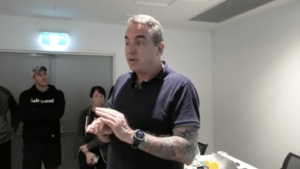
LEARNING OUTCOMES
By the end of the workshop, participants will be able to:
- Understand muscle dysfunction beyond trigger points and pain
- Recognise patterns of inhibition, compensation, and overload
- Apply motor point acupuncture with greater precision and purpose
- Integrate biomechanical and neurological reasoning into clinical practice
- Improve confidence when managing complex and recurrent musculoskeletal cases
ABOUT THE PRESENTER

Dr. Rich Hazel, DAc
Dr. Rich Hazel uses a unique style of acupuncture that relies heavily on knowledge of neurology and sports medicine. He was one of very few people to learn Motor Point Acupuncture at Pacific College of Oriental Medicine in New York where he completed his Master of Science in Acupuncture, Orthopedic & Sports Medicine. Rich has also studied Neurofunctional Acupuncture and Exstore Functional Muscle Assessment with some of the best orthopedic acupuncturists in North America and spent years studying trigger points and the treatment of myofascial pain from the works of Dr. Janet Travell and Dr. C Chan Gunn.
His unique style allows Rich to get excellent results for sports injuries, sports mobility and performance, and acute and chronic pain of all kinds. He now teaches this unique style of acupuncture to other acupuncturists in the US and abroad and is on the faculty at Pacific College of Oriental Medicine in New York.
DETAILS
Date: Friday 15th May to Sunday 17th May 2026
Time: 9am – 5.30pm (on all 3 days)
Venue: Vibe Hotel – 111 Goulburn Street, Sydney NSW 2000
CPD: 19.5 CPD Points
Included: Notes, Morning Tea, Afternoon Tea
PRICING
Deposit: $300
Early Bird Prices (ENDS 8TH MAY 2026)
Practitioner Rate: $1650
Student (Full Time – Undergraduate): $1550
Regular Prices
Practitioner Rate: $1850
Student (Full Time – Undergraduate): $1750
TERMS & CONDITIONS
Early Bird: Full payment is required 4 weeks prior to the start of the Seminar and Workshop
Registrations cancelled up to one week prior to the seminar will be refunded less 20%. We regret that refunds are not otherwise possible.
RECORDING
If you wish to purchase for the recording only, please contact us to register your name. We will inform you that it will be available to purchase once it is ready. Please allow 3-4 weeks after the live seminar end date for the recording to be released.
Recording (Revisit) Access Fee for live participants and recording purchase – 5 years: $99